
Texas is moving from planning a major expansion of its electric transmission system to deciding where the first wave of new lines will cross private property. For landowners in Central and West Texas, these are not isolated projects. They are parts of a broader system intended to move more electricity into and across the Permian Basin.
That distinction matters because several major cases are moving through the Public Utility Commission of Texas at the same time, often on compressed schedules. A decision in one proceeding can also provide context for the projects around it.
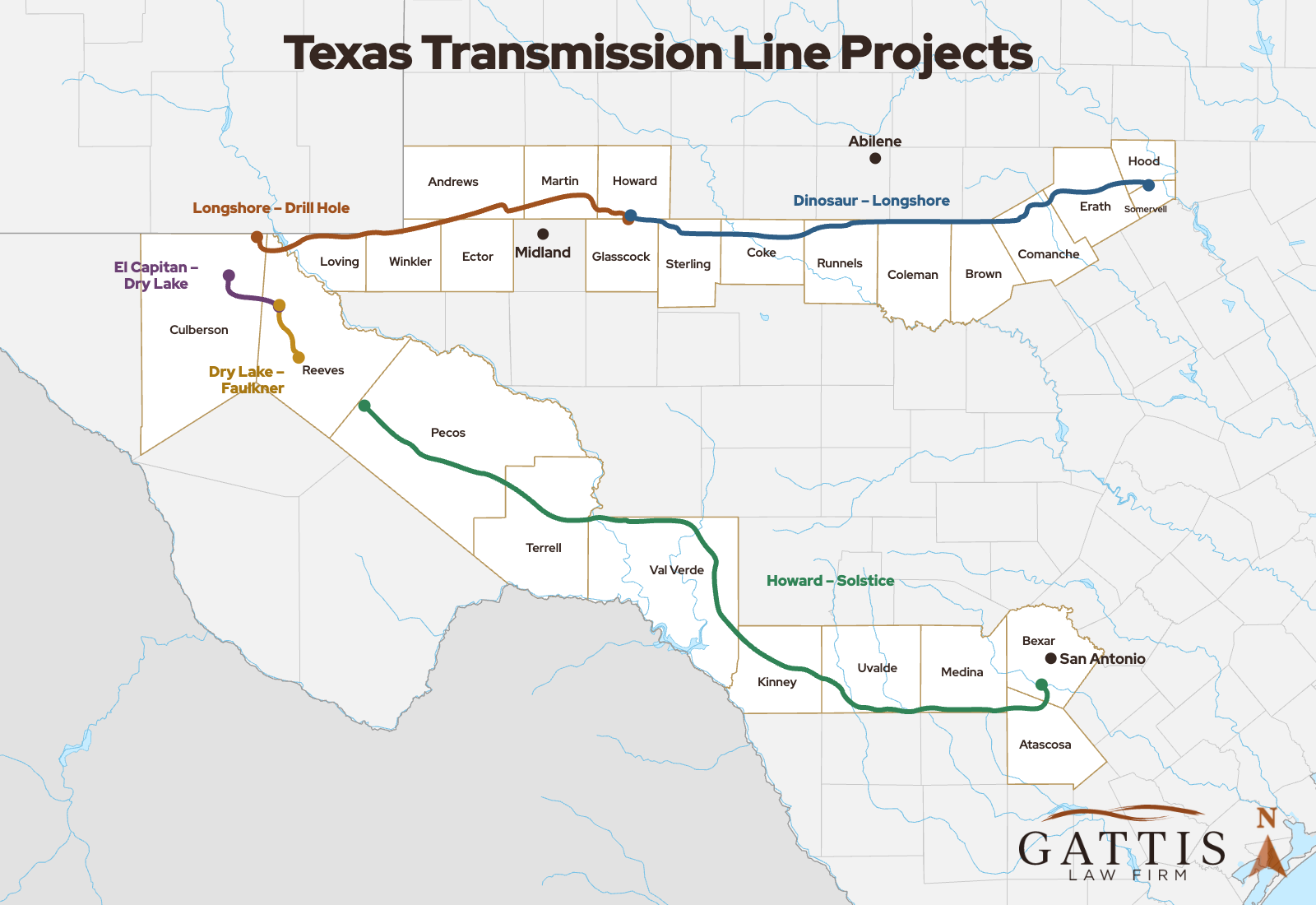
This Is One System, Not Isolated Projects
The current filings are part of a larger transmission buildout tied to the Permian Basin Reliability Plan. The PUCT approved the plan in October 2024 and later approved major import paths intended to support the region’s growing electricity needs.
Several of the 765-kV lines now before the Commission are grouped within the first phase of the Strategic Transmission Expansion Plan. Other projects, including Howard to Solstice, arise from the same overall reliability effort. Together, they form a connected network rather than a collection of unrelated local lines.
For landowners, the practical issue is still property-specific: whether an approved route crosses or comes near their land. But understanding the larger system helps explain why so many proceedings are moving forward at once.
Why the Current Phase Matters
Each project discussed below is or recently has been in a Certificate of Convenience and Necessity proceeding. During that process, utilities submit possible routes, notify affected landowners and present evidence supporting the project. Contested cases may be referred to the State Office of Administrative Hearings before the Commission approves the route that may be built.
The central question at this stage is where the line will go. Final easement acquisition and compensation generally follow route approval, although landowners may receive survey requests, notices or other preliminary contacts before the Commission issues its decision.
Texas law now generally requires the PUCT to approve or deny a new transmission-line CCN application within 180 days of filing. That timetable has placed these large, complicated cases on an unusually compressed schedule.
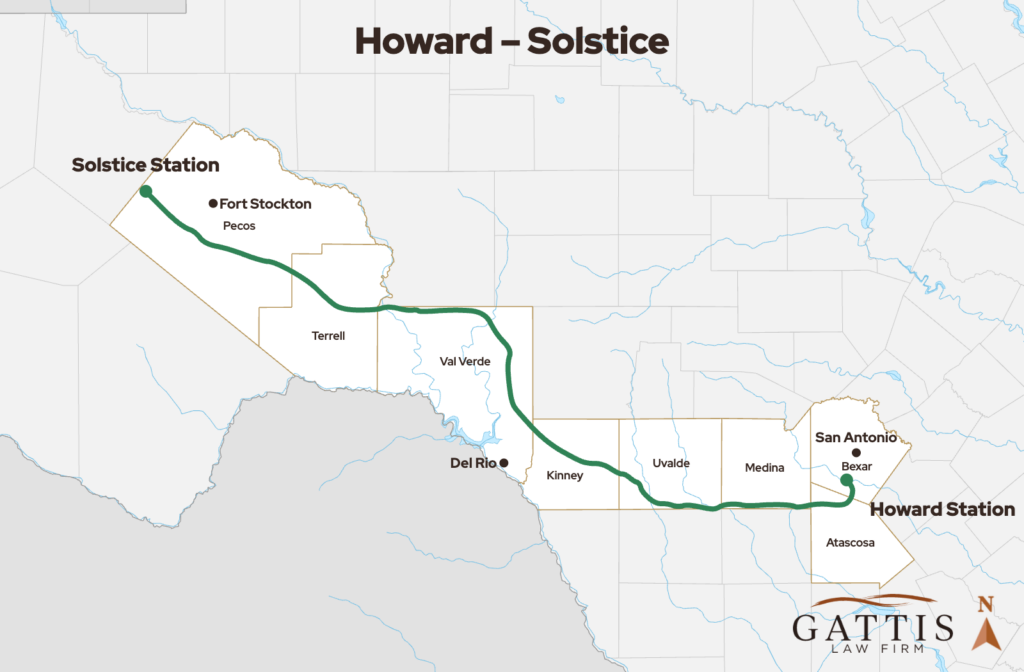
The Howard to Solstice 765-kV Single-Circuit Transmission Line connects CPS Energy’s Howard Road Station in Bexar County with AEP Texas’s Solstice Station in Pecos County. CPS Energy and AEP Texas filed the joint application on March 2, 2026, under PUC Docket No. 59336.
The application considered 77 alternative routes made up of 268 segments across 14 Central and West Texas counties, with route lengths ranging from roughly 335 to 393 miles. Current project information estimates that roughly 700 parcels may be affected.
On July 27, 2026, the administrative law judges at the State Office of Administrative Hearings recommended Route 4 in their Proposal for Decision. The Commission approved a modified alignment, Route 4 Modification 1, at its September 11, 2026 open meeting and issued its Final Order on September 18, 2026.
Right-of-way activity is anticipated from summer 2026 through fall 2028. With the route now approved, landowners along Route 4 Modification 1 may see survey, appraisal and easement-acquisition activity move forward.
For the approved route map and answers to common landowner questions, see our Howard to Solstice 765kV Transmission Line project page.

Bell County East to Big Hill
Oncor Electric Delivery Company and LCRA Transmission Services Corporation filed the Bell County East Switch to Big Hill Substation 765-kV Transmission Line application on March 26, 2026, under PUC Docket No. 59475.
Current project information describes an approximately 200-mile line crossing Bell, Burnet, McCulloch, Menard, Mills, San Saba and Schleicher Counties. The utilities estimate that roughly 500 parcels may be affected, with right-of-way work expected from late 2026 through late 2028 and construction currently anticipated in mid-2028.
Oncor and LCRA TSC have identified Route 894 as their selected route. That selection remains subject to final PUCT approval, and the Commission may approve a different route when it issues its Final Order, currently anticipated in September 2026.
Landowners whose property lies along Route 894 should begin preparing for possible right-of-way contact and easement discussions if the Commission approves it. Those along alternative routes should continue to monitor the case until the Final Order confirms where the line may be built.

Big Hill to Sand Lake
The Big Hill Substation to Sand Lake Switch 765-kV Transmission Line is a joint Oncor and LCRA TSC project filed on January 15, 2026, under PUC Docket No. 59182. It is one of the more advanced cases in this group.
Current project information describes an approximately 177-mile line crossing Crane, Irion, Reagan, Schleicher, Upton and Ward Counties. The utilities estimate that roughly 500 parcels may be affected, with right-of-way work expected from early 2027 through late 2029 and construction currently anticipated in late 2029.
On June 10, 2026, the SOAH administrative law judges recommended Route 228 in their Proposal for Decision. The PUCT must still issue the controlling decision and may adopt, modify or reject that recommendation. A Final Order had been anticipated in July 2026, and the project is expected to be in service by the end of 2030.
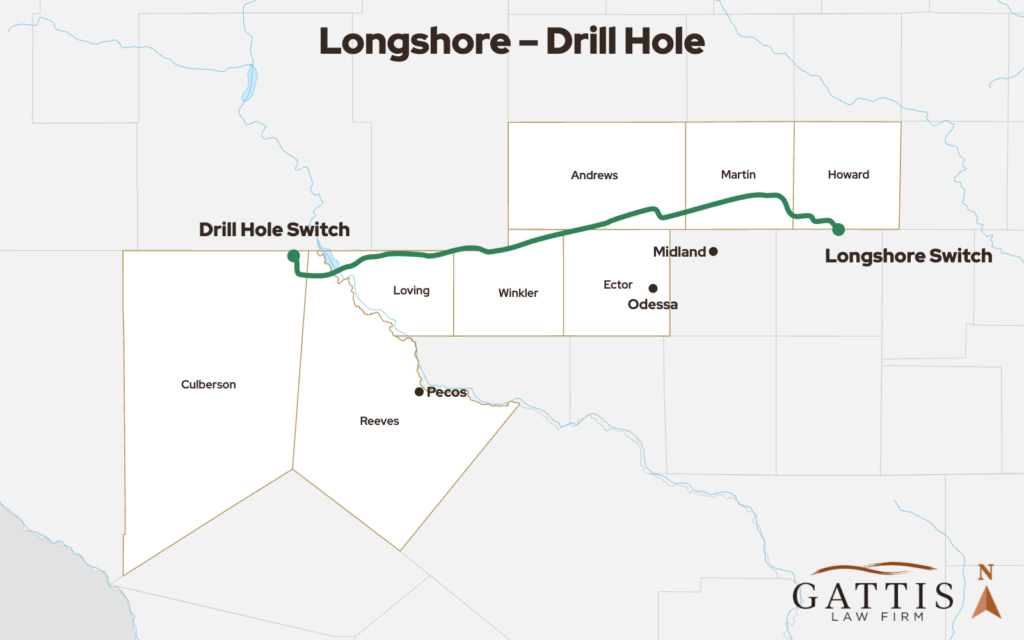
Oncor filed the Longshore Switch to Drill Hole 765-kV Transmission Line application on December 11, 2025, under PUC Docket No. 59029. Current project information describes an approximately 160-mile line crossing Ector, Howard, Loving, Martin, Reeves and Winkler Counties and estimates that roughly 225 parcels may be affected.
On May 12, 2026, the SOAH administrative law judges recommended Route 476 in their Proposal for Decision. On August 28, 2026, the PUCT approved the project and adopted Route 476 as the approved route. Oncor currently plans to complete the project in 2029.
Right-of-way activity was anticipated to begin in summer 2026. Landowners along Route 476 should understand what the approved route means for their property and for the easement-acquisition process that follows.
For the approved route map and answers to common landowner questions, see our Longshore to Drill Hole 765kV Transmission Line project page.
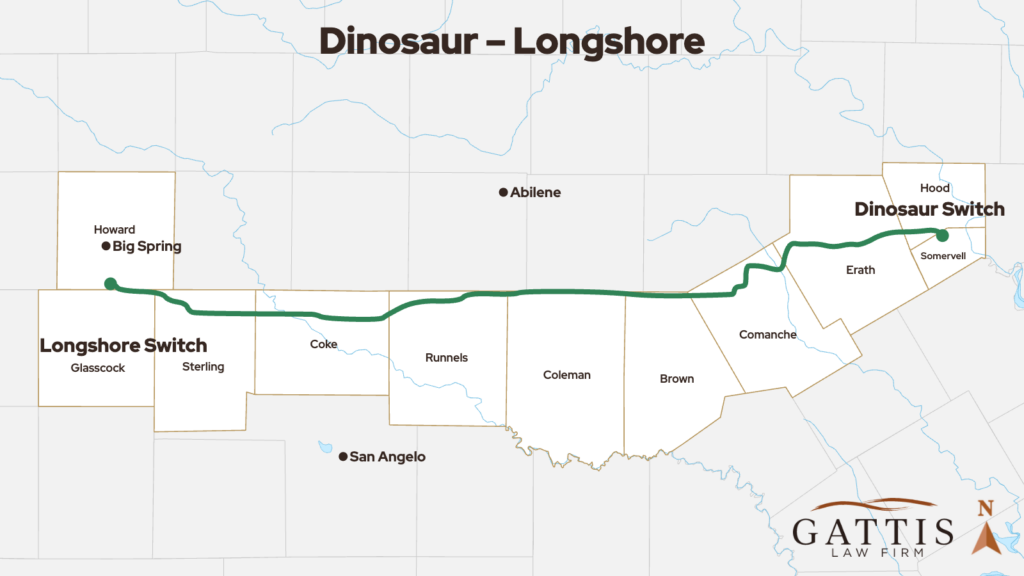
The Dinosaur to Longshore 765-kV Transmission Line has generated some of the most visible opposition among the current projects. Oncor filed the application on February 19, 2026, under PUC Docket No. 59315. The application considered 130 alternative routes spanning approximately 235 to 270 miles, and current project information estimates that roughly 550 parcels may be affected.
On July 24, 2026, the SOAH administrative law judges recommended Route 559 in their Proposal for Decision. On August 28, 2026, the PUCT approved the project and adopted Route 559 as the approved route. Oncor currently plans to complete the project in 2029.
Opposition has focused on private-property impacts and the proximity of some proposed routes to sensitive areas, including Dinosaur Valley State Park. With Route 559 approved, right-of-way activity is anticipated from 2027 through 2029.
For the approved route map and answers to common landowner questions, see our Dinosaur to Longshore 765kV Transmission Line project page.
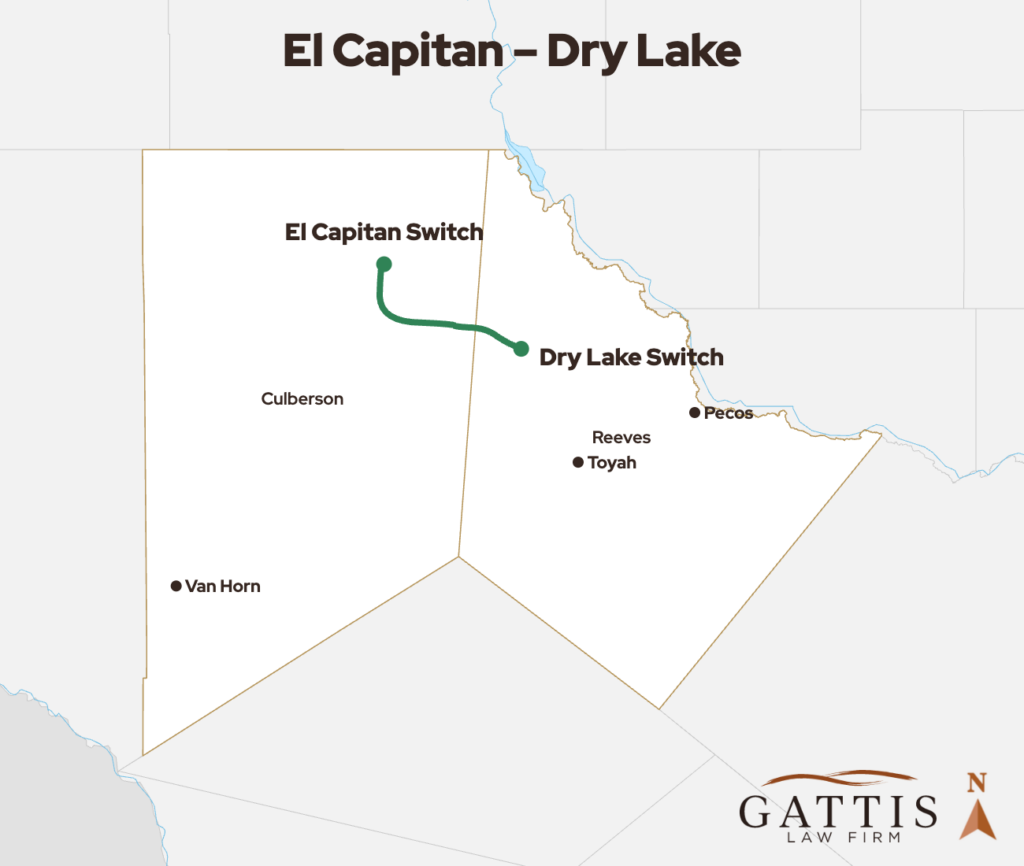
The El Capitan to Dry Lake project is an approved double-circuit 345-kV line connecting Oncor’s planned El Capitan Switch in Culberson County to its proposed Dry Lake Switch in Reeves County. Oncor filed the approximately 25-mile project on February 26, 2026, under PUC Docket No. 59353. Current information estimates that roughly 100 parcels may be affected.
On July 15, 2026, the SOAH administrative law judges recommended Route 89 in their Proposal for Decision. On August 20, 2026, the PUCT approved the project and adopted Route 89 as the approved route. The project is expected to be in service by fall 2028.
Right-of-way activity is anticipated in fall 2026. Landowners along Route 89 should understand what any survey access request or easement offer authorizes before agreeing to it.
For the approved route map and answers to common landowner questions, see our El Capitan to Dry Lake 345kV Transmission Line project page.
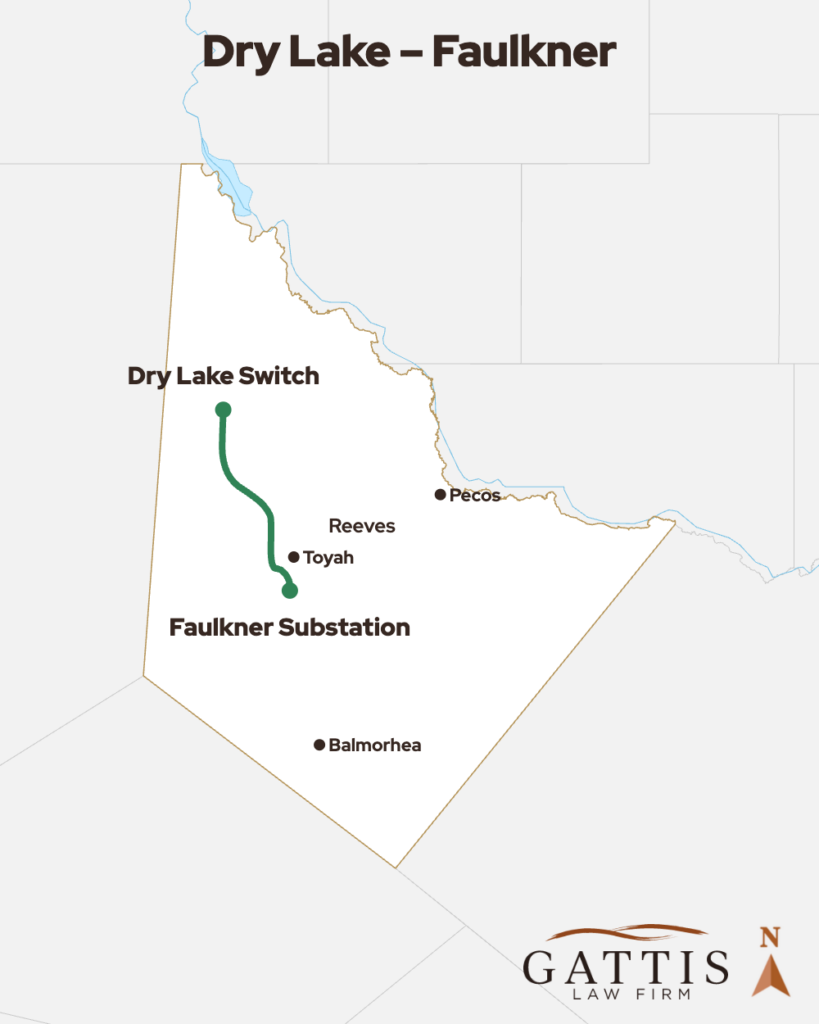
Oncor and Texas-New Mexico Power Company filed the Dry Lake to Faulkner 345-kV Transmission Line application on March 24, 2026, under PUC Docket No. 59487. The approved double-circuit line runs approximately 24 miles within Reeves County, connecting Oncor’s planned Dry Lake Switch with TNMP’s proposed Faulkner Substation. Current information estimates that roughly 100 parcels may be affected.
Route 75 was identified as the selected route during the proceeding. On September 11, 2026, the PUCT issued its Order approving the project and Route 75. The project is expected to be in service by fall 2028.
Right-of-way activity is anticipated to begin in late 2026. Landowners in Reeves County along or near Route 75 should understand exactly what any survey access request, easement offer or other contact authorizes.
For the approved route map and answers to common landowner questions, see our Dry Lake to Faulkner 345kV Transmission Line project page.
The Pattern Across These Projects
The most important distinction is among a utility-selected route, a route recommended by SOAH and a route approved by the PUCT. A utility may identify the route it supports, and the administrative law judges may recommend a route in a Proposal for Decision. Neither controls until the Commission issues its Final Order.
Once the PUCT approves a route, the opportunity to influence where the line will go is largely over. The focus then shifts toward survey access, easement terms, valuation and compensation. That is why it matters to understand a project’s status as soon as notice arrives.
Current Status Snapshot
Howard to Solstice: PUCT approved Route 4 Modification 1 on September 11, 2026; Final Order issued September 18, 2026.
Bell County East to Big Hill: Oncor and LCRA TSC selected Route 894, subject to final PUCT approval; Final Order anticipated in September 2026.
Big Hill to Sand Lake: SOAH recommended Route 228 on June 10, 2026; a Commission decision had been anticipated in July 2026.
Longshore to Drill Hole: PUCT approved Route 476 on August 28, 2026; completion planned for 2029.
Dinosaur to Longshore: PUCT approved Route 559 on August 28, 2026; completion planned for 2029.
El Capitan to Dry Lake: PUCT approved Route 89 on August 20, 2026; in service expected by fall 2028.
Dry Lake to Faulkner: PUCT approved Route 75 in an Order signed September 11, 2026; in service expected by fall 2028.
What Landowners Need to Know
Landowners may be contacted at different points in the process. A notice about a proposed route is not the same as an offer to purchase an easement. A survey request is not the same as an easement agreement. Each document should be evaluated based on what it actually authorizes.
If the PUCT approves a route across your property, the utility may seek to acquire an easement voluntarily. If an agreement cannot be reached, a utility with eminent-domain authority may pursue condemnation. Texas law requires just compensation, but compensation is only one part of an easement agreement. Width, access, construction practices, restoration, drainage, gates, future use and other terms may also affect the property for years.
Before signing a survey permission form, option, easement agreement or other document, consider having an experienced eminent-domain attorney review it. Early advice can help a landowner understand which decisions are urgent and which issues may still be negotiated.
Learn More About Your Rights
How Gattis Law Can Help
Gattis Law represents Texas landowners facing transmission lines, pipelines, and other projects involving eminent domain. The firm helps property owners understand notices and survey requests, evaluate proposed easements, assess compensation, and protect their interests if condemnation proceedings begin.
Dan Gattis is both an attorney and a landowner. He understands that these projects affect more than acreage on a map—they can affect access, operations, family plans, and the long-term use and value of the land.
The Future of Texas Transmission
Texas’s transmission expansion is no longer only a long-range plan. The PUCT has now approved routes for five of these projects, covering hundreds of miles of new lines across West and Central Texas.
More projects are likely to follow. Landowners who understand the difference between a proposed route, a utility-selected route, a SOAH-recommended route and a PUCT-approved route will be better prepared to protect their rights at each stage.
Contact the Gattis Law Firm
If you receive notice that your property may be affected by one of these transmission projects, do not wait until the route and easement terms are settled. Contact Gattis Law for a free, no-obligation consultation to understand where the case stands and what options remain available to you.
